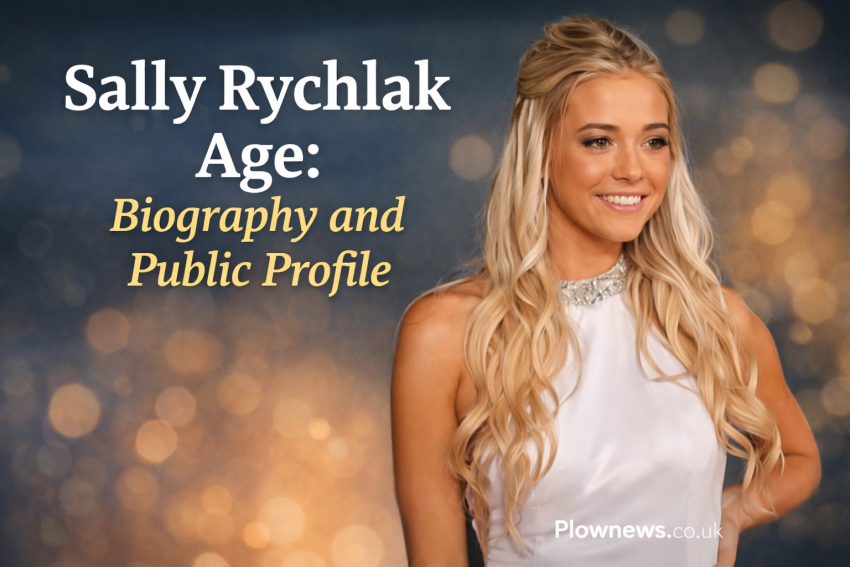
In the digital age, public curiosity can rise quickly, often without a clear starting point. One photo, a brief mention in the media, or a connection to a well-known public figure can suddenly place a previously private individual into the spotlight. That is precisely how interest in Sally Rychlak has grown. As her name began circulating online, one question surfaced repeatedly: What is Sally Rychlak’s age?
While the question seems simple, the answer is not as straightforward as many online biographies suggest. Sally Rychlak has maintained a relatively private life, and much of the information circulating about her has been inferred rather than officially confirmed. This article offers a biography-style look at her life, focusing on what can be responsibly stated, what remains uncertain, and why accuracy matters when discussing personal details.
Who Is Sally Rychlak?
Sally Rychlak is best known for her professional background in higher education development and for her association with the University of Mississippi community. She has worked in roles related to fundraising, alumni engagement, and institutional advancement, areas that require discretion, relationship-building, and long-term strategic thinking. Her professional reputation has largely been shaped within academic and nonprofit circles rather than through public-facing celebrity culture.
Public interest in her life expanded after media coverage linked her romantically to college football coach Lane Kiffin. As a result, her name began appearing in entertainment articles, social media discussions, and online biography websites. Despite this increased visibility, she has not positioned herself as a public figure in the traditional sense.
Sally Rychlak Age: What Is Publicly Known
The most searched detail about Sally Rychlak is her age. However, there is no confirmed public record, verified interview, or authoritative biography that clearly states her exact birthdate or age. Many websites publish a specific age or birth year, but these claims often lack sourcing or rely on circular references from other low-credibility sites.
What can be responsibly stated is that Sally Rychlak has not publicly disclosed her age in any primary source. As a result, any exact number attached to her age should be treated with caution. The absence of confirmation does not indicate secrecy; rather, it reflects her choice to maintain personal boundaries despite growing public interest.
Estimated Age Range and Online Speculation
Some online writers attempt to estimate Sally Rychlak’s age based on publicly available milestones, such as her college graduation year. Several sources indicate that she completed her undergraduate education around 2019. In the United States, most students graduate between the ages of twenty-one and twenty-three, although this varies widely depending on individual circumstances.
Based on this timeline alone, some observers infer that she may be in her mid-to-late twenties. However, it is important to emphasize that this is an estimate, not a confirmed fact. Graduation age can differ due to gap years, early enrollment, graduate studies, or part-time education. Responsible biographical writing distinguishes clearly between inference and verified information.
Early Life and Education
Details about Sally Rychlak’s early life remain limited in the public domain. She appears to have grown up in the southern United States and pursued higher education with a focus on communication, development, or related fields. Her academic path suggests a strong interest in organizational relationships and long-term institutional growth.
Her time in college played a significant role in shaping her professional direction. By the time she entered the workforce, she had already aligned herself with roles that required professionalism, discretion, and interpersonal skill. These traits would later define her work in university advancement.
Professional Career and Accomplishments
Sally Rychlak’s career has centered on higher education development, a field that operates largely behind the scenes. Professionals in this area support universities by cultivating donor relationships, managing fundraising campaigns, and strengthening alumni networks. Success in this field is measured less by public recognition and more by trust and long-term impact.
Her association with the University of Mississippi placed her within a respected institutional environment. Colleagues and professional profiles describe her as organized, committed, and relationship-oriented. These qualities have contributed to her steady career growth and professional credibility.
Public Attention and Media Exposure
Sally Rychlak’s increased media exposure did not come from her career but from her personal life. When her relationship with Lane Kiffin became public, media outlets began referencing her name more frequently. This shift introduced her to a broader audience that was unfamiliar with her professional background.
With that exposure came speculation, particularly around her age and personal history. Many articles prioritized quick facts over accuracy, leading to the spread of unverified information. This phenomenon is common when private individuals become connected to public figures, and it often results in oversimplified or misleading biographies.
Privacy, Accuracy, and Responsible Biography
Age is a deeply personal detail, even in an era where information feels readily accessible. The lack of confirmed data about Sally Rychlak’s age highlights an important ethical consideration in modern biography writing. Not every personal detail is automatically public simply because there is interest in it.
High-quality biographical writing respects both the reader’s curiosity and the subject’s right to privacy. In Sally Rychlak’s case, responsible reporting means acknowledging uncertainty rather than presenting assumptions as fact. This approach aligns with modern journalistic standards and with evolving expectations around digital ethics.
Why Her Age Continues to Generate Interest
The continued search for Sally Rychlak’s age reflects broader cultural patterns. Audiences often look for numerical markers, such as age, to contextualize relationships and public narratives. Age becomes a shorthand for understanding compatibility, life stage, or power dynamics, even when such conclusions are overly simplistic.
In reality, age alone reveals very little about a person’s character, achievements, or intentions. Sally Rychlak’s professional accomplishments and personal choices cannot be reduced to a number, especially one that has not been confirmed.
Conclusion
Sally Rychlak’s biography is a reminder that public interest does not always come with clear information. While her name has become widely searched, particularly in relation to her age, there is no verified public source that definitively answers that question. What is known paints the picture of a capable professional with a background in higher education advancement and a preference for privacy.
Rather than focusing on unverified numbers, a more accurate and respectful approach is to understand her life through confirmed milestones, professional contributions, and the context in which public attention emerged. In doing so, readers gain a clearer, more honest portrait of Sally Rychlak—one that values accuracy over assumption and substance over speculation.